About the Journal
|
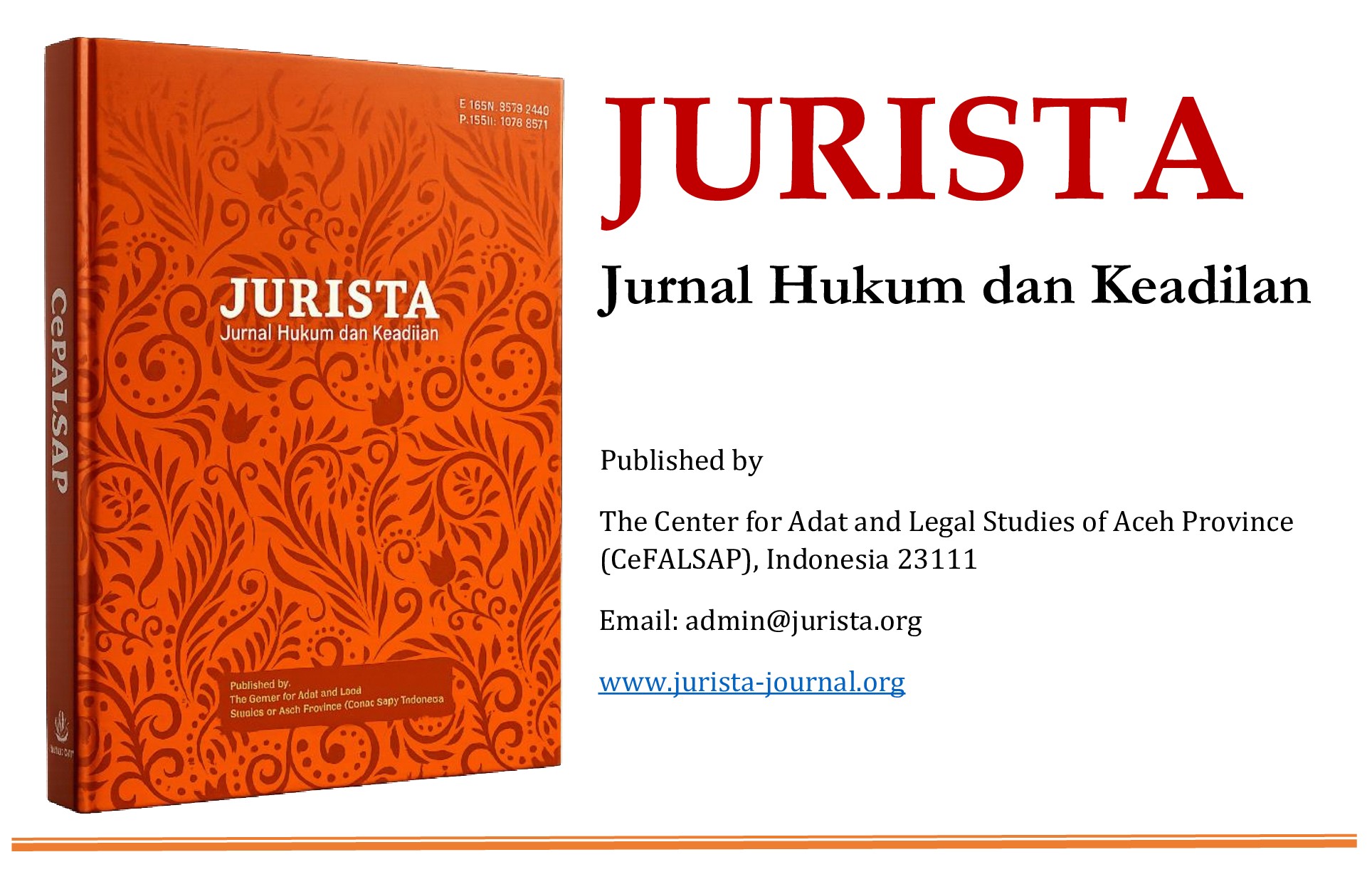
JURISTA: Jurnal Hukum dan Keadilan (JJHK) 1979-8571 (print) | ISSN 2579-8642 (online) is a peer-reviewed, open-access scholarly journal published by the Centre for Adat and Legal Studies of Aceh Province (CeFALSAP), Indonesia. The journal employs a double-blind peer-review process and provides an international platform for original legal research addressing the development, interpretation, implementation, and transformation of law and justice.
JURISTA aims to advance legal scholarship by examining the relationships between state law, customary legal traditions, Islamic legal principles, and international and transnational legal frameworks. While maintaining a particular interest in legal developments in Indonesia and Southeast Asia, the journal welcomes research from all jurisdictions that contributes to broader theoretical, comparative, and contemporary debates in law.
The journal prioritises research demonstrating conceptual originality, methodological rigour, critical legal reasoning, and substantive contributions to legal knowledge. It encourages doctrinal, comparative, theoretical, and empirical socio-legal approaches that deepen understanding of legal institutions, rights, obligations, governance, and access to justice.
Focus and Scope
JURISTA welcomes original research articles within the following six interconnected areas of legal scholarship:
- Legal Pluralism, Customary Law, and Indigenous Rights
- Islamic Law and Sharia Economic Governance
- Constitutional Law, Public Governance, and Justice Institutions
- Private Law, Commercial Regulation, and Digital Justice
- International, Transnational, and Comparative Law
- Law, Society, and Sustainable Justice
Research Orientation and Editorial Priorities
JURISTA particularly encourages manuscripts that establish a clear legal research problem, engage critically with relevant scholarly debates, and present findings that contribute to the development of legal theory, doctrine, institutional practice, or comparative understanding.
The journal welcomes research employing doctrinal legal analysis, comparative legal methods, normative legal theory, case-law analysis, empirical socio-legal investigation, and interdisciplinary methodologies where the legal dimension remains central.
Research based on a single jurisdiction, legal institution, community, or case study is welcome when its analysis offers broader conceptual, comparative, methodological, or policy-relevant insights.
Scope Limitations
To maintain a coherent disciplinary focus and consistent academic standards, JURISTA generally does not consider manuscripts that:
- Merely summarise legislation, judicial decisions, or established legal doctrines without original critical analysis.
- Present descriptive accounts of local practices without a clearly defined legal research question or substantive scholarly contribution.
- Address general political, economic, religious, or social issues without a substantial legal framework or analytical engagement with law.
- Offer personal opinions, advocacy statements, or policy recommendations unsupported by rigorous legal reasoning and appropriate evidence.
All manuscripts are assessed according to their originality, analytical depth, methodological transparency, scholarly significance, and consistency with the journal's stated aims and scope.
JURISTA seeks to promote rigorous, inclusive, and internationally relevant legal scholarship that contributes to a deeper understanding of law, justice, and the institutions through which legal norms are developed and applied.
Benefits to authors: We also offer many author benefits, such as free PDFs, a liberal copyright policy, publication free of charge, and much more. Please see our guide for authors for information on article submission. If you require any further information or help, please visit our Support Centre.
Current Issue
Vol. 10 No. 1 (2026): JURISTA: Jurnal Hukum dan Keadilan

Published:
01.06.2026